The upcoming year plans to bring exciting technological breakthroughs. The “physical realm” of commerce will continue to dissolve, in 2019 and we’ll enter the age of “Experience-Driven, Unified Commerce”. A new type of retail paradigm where connectivity is ubiquitous, will exists without borders, and payment credentials are stored in the cloud. Consumers will interact with a host of “gateway” devices including smartphones, tablets, voice assistants, smartwatches, appliances, clothing, fashion accessories, automobiles, and more…anytime and everywhere. In order to keep up with the increasing demand for quick resolution and 24/7 accessibility, customer service will become increasingly automated, with AI-enabled live chat and virtual assistants becoming dominant communication channels.
The physical store of the future will be a significantly more digitized version of what exists today, with multiple smart devices working together on a single IoT platform to deliver hyper-personalized, adaptive and context specific experiences. AI will soon be applied across the entire retail product and service cycle, in areas such as product design and manufacturing, demand forecasting, supply chain management, price and assortment optimization, merchandising, promotions, customer experience. personalization, and post-sale customer service.
With AI and deep learning, retailers can use prediction analysis to determine which products might not sell under certain conditions – including market, economic, competitor and weather related factors – and create a combination of targeted discounts, dynamic, pricing, free shipping, enhanced services, product combinations etc., to clear out the inventory that is most likely not to sell after a certain period.
Patrick Berlinquette says:Google provides marketers like me with so much of your personal data that we can infer more about you from it than from any camera or microphone
For as long as you’ve been using Google, Google has been building a “citizen profile” on you. This profile contains:
A complete checklist of everything Google knows about you—thereby all the ways you’re tracked—as of December 2018:Every internet search contains keywords, and the keywords you just entered into Google are fought over by advertisers.
Your age
Your income
Your gender
Your parental status
Your relationship status
Your browsing history (long-term and short-term)
Your device (phone, tablet, desktop, TV)
Your physical location
The age of your child (toddler, infant, etc.)
How well you did in high school
The degree you hold
The time (of day) of your Google usage
The language you speak
Whether you’ve just had a major life event
Your home ownership status
Your mobile carrier
The exact words you enter into Google search
The context and topics of the websites you visit
The products you buy
The products you have almost bought
Your Wi-Fi type
Your proximity to a cell tower
Your app installation history
The amount of time you spend on certain apps
Your operating system
The contents of your email
The time you spend on certain websites
Whether you’re moving (e.g., into a new home)
Whether you’re moving (e.g., walking or on a train)
* The above targeting methods are made available to search engine marketers by Google within marketers’ Ads UI. Info is also freely available here
A company now has a workforce of at least 80 employees with implanted RFID chips in their hands to help them go about their work routines more efficiently. Three Square Markets, has facilitated the implantation of sensors about the size of a very large grain of rice within employees on a voluntary basis. The purpose is to do things like get into the office, log on to computers, and buy food and drinks in the company cafeteria. Essentially, participating employees can access systems and buy food in the cafeteria simply by waving their hands.
The microchips Three Square Market employees had injected in their hands are about the size of a big grain of rice.
Three Square Markets, software engineer reportedly uses his chip 10 to 15 times a day. It has become such a part of his routine that swiping his hand over an RFID reader plugged into his computer is no different from typing in his password on a keyboard. Other employees also report becoming accustomed to simply waving their hands to gain access to services throughout their workdays
Fortnite for Android won’t be available from the Google Play store. Epic will force gamers to sideload the game, just as a leak revealed a few days ago. And the reason why Epic is doing it is to prevent Google from taking its 30% cut of in-app purchases. The game is free to play, but Epic makes a fortune from in-app purchases.
Ransomware is a form of malicious software — malware — which encrypts documents on a PC or even across a network. Victims can often only regain access to their encrypted files and PCs by paying a ransom to the criminals behind the ransomware.
A ransomware infection often starts with someone clicking on what looks like an innocent attachment, and it can be a headache for companies of all sizes if vital files and documents (think spreadsheets and invoices) are suddenly encrypted and inaccessible. But that’s not the only way to get infected.
What is the history of ransomware?
While ransomware exploded last year, increasing by an estimated 748 percent, it’s not a new phenomenon: the first instance of what we now know as ransomware appeared in 1989.
Known as AIDS or the PC Cyborg Trojan, the virus was sent to victims — mostly in the healthcare industry — on a floppy disc. The ransomware counted the number of times the PC was booted: once it hit 90, it encrypted the machine and the files on it and demanded the user ‘renew their license’ with ‘PC Cyborg Corporation ‘ by sending $189 or $378 to a post office box in Panama.
The AIDS demand for payment — by post. Image: Sophos
How did ransomware evolve?
This early ransomware was a relatively simple construct, using basic cryptography which mostly just changed the names of files, making it relatively easy to overcome.
But it set off a new branch of computer crime, which slowly but surely grew in reach — and really took off in the internet age. Before they began using advanced cryptography to target corporate networks, hackers were targeting general internet users with basic ransomware.
One of the most successful variants was ‘police ransomware’, which tried to extort victims by claiming to be associated with law enforcement. It locked the screen with a ransom note warning the user they’d committed illegal online activity, which could get them sent to jail.
However, if the victim paid a fine, the ‘police’ would let the infringement slide and restore access to the computer by handing over the decryption key.
An example of ‘police ransomware’ threatening a UK user. Image: Sophos
.
What are the main types of ransomware?
Ransomware is always evolving, with new variants continually appearing in the wild and posing new threats to businesses. However, there are certain types of ransomware which have been much more successful than others.
Perhaps the most notorious form of ransomware is Locky, which terrorised organizations across the globe throughout 2016. It infamously made headlines by infecting a Hollywood hospital. The hospital gave into the demands of cybercriminals and paid a $17,000 ransom to have its networks restored.
Locky remained successful because those behind it regularly update the code to avoid detection. They even update it with new functionality, including the ability to make ransom demands in 30 languages, so criminals can more easily target victims around the world. Locky became so successful, it rose to become most prevalent forms of malware in its own right.
Cryptowall is another form of ransomware which has found great success for a prolonged period of time. Starting life as doppelganger of Cryptolocker, it’s gone onto become one of the most successful types of ransomware.
One of the most common forms of ransomware distributed in this way is Cerber, which infected hundreds of thousands of users in just a single month. The original creators of Cerber are selling it on the Dark Web, allowing other criminals to use the code in return for 40 percent of each ransom paid.
Cerber ransomware became so successful that it surpassed Locky — which appeared to mysteriously disappear over Christmas, although reemerged in April with new attack techniques — to become the most dominant form of ransomware on the web, accounting for 90 percent of ransomware attacks on Windows as of mid-April 2017.
The cryptography behind Cerber is so advanced that there’s currently no decryption tools available to help those infected by the latest versions.
Cerber now comes with the ability to steal to steal bitcoin wallet and password information, in addition to encrypting files.
In exchange for giving up some of the profits for using Cerber, wannabe cyber-fraudsters are provided with everything they need in order to successfully make money through the extortion of victims.
What is WannaCry ransomware?
In the biggest ransomware attack to date, WannaCry — also known as WannaCrypt and Wcry — caused chaos across the globe in an attack which started on Friday 12 May 2017. WannaCrypt ransomware demands $300 in bitcoin for unlocking encrypted files — a price which doubles after three days. Users are also threatened, via a ransom note on the screen, with having all their files permanently deleted if the ransom isn’t paid within a week.
WannaCry ransomware infected Windows XP systems across the globe. Image: Cisco Talos
More than 300,000 victims in over 150 countries fell victim to the ransomware over the course of one weekend, with businesses, governments, and individuals across the globe all affected.
Healthcare organisations across the UK had systems knocked offline by the ransomware attack, forcing patient appointments to be cancelled and hospitals telling people to avoid visiting Accident and Emergency departments unless it was entirely necessary.
Of all the countries affected by the attack, Russia was hit the hardest, according to security researchers, with the WannaCry malware crashing Russian banks, telephone operators, and even IT systems supporting transport infrastructure. China was also hit hard by the attack, with 29,000 organizations in total falling victim to this particularly vicious form of ransomware.
Other high-profile targets included the car manufacturer Renault which was forced to halt production lines in several locations as the ransomware played havoc with systems.
What all the targets had in common is that they were running unsupported versions of Microsoft Windows, including Windows XP, Windows 8, and Windows Server 2003.
The ransomware worm is so potent because it exploits a known software vulnerability called EternalBlue. The Windows flaw is one of many zero-days which apparently was known by the NSA — before being leaked by the Shadow Brokers hacking collective. Microsoft released a patch for the vulnerability earlier this year — but only for the most recent operating systems.
In response to the attack, Microsoft took the unprecedented step of issuing patches for unsupported operating systems to protect against the malware.
It was almost three months before the WannaCry attackers finally withdrew the funds from the WannaCry bitcoin wallets — they made off with a total of $140,000 thanks to fluctuations in the value of bitcoin.
But despite critical patches being made available to protect systems from WannaCry and other attacks exploiting the SMB vulnerability, a large number of organisations seemingly chose not to apply the updates.
Petya ransom note Image: Symantec
But that’s a relatively modest loss in comparison to other victims of the attack: shipping and supply vessel operator Maersk and goods delivery company FedEx have both estimated losses of $300m due to the impact of Petya.
In February 2018, the governments of the United Kingdom, the United States, Australia and others officially declared that the NotPetya ransomware had been the work of the Russian military. Russian denies any involvement.
What is Bad Rabbit ransomware?
October 2017 saw the third high profile ransomware attack of the year when organizations in Russia and Ukraine fell victim to a new variant of Petya ransomware.
Dubbed Bad Rabbit, it infected at least three Russian media organisations while also infiltrating the networks of several Ukrainian organisations including the Kiev Metro and Odessa International Airport – at the time, the airport said it had fallen victim to a ‘hacker attack’.
The initial attack vector used to distribute Bad Rabbit was drive-by downloads on hacked websites – some of which had been compromised since June. No exploits were used, rather visitors were told they had to install a phony Flash update, which dropped the malware.
Bad Rabbit ransom note Image: Kaspersky Lab
Like NotPetya before it, Bad Rabbit spread through networks using a leaked NSA hacking tool – but this time it was via the EternalRomance SMB vulnerability, rather than the EternalBlue exploit.
Analysis of Bad Rabbit shared much of its code – at least 67 percent – with Peyta and researchers at Cisco Talos concluded that this, combined with how it uses SMB exploits, means there’s “high confidence” in a link between the two forms of ransomware – and that they could even share the same author.
Bad Rabbit was named after the text which appeared at the top of the Tor website hosting the ransom note. Some security researchers joked it should’ve been named after the lines in the code referencing characters from Game of Thrones.
SpriteCoin ransomware demands payment in Monero. Image: Fortinet.
How do you prevent a ransomware attack?
With email being by far the most popular attack vector for ransomware, you should provide employees with training on how to spot an incoming malware attack. Even picking up on little indicators like poor formatting or that an email purporting to be from ‘Microsoft Security’ is sent from an obscure address which doesn’t even contain the word Microsoft within it might save your network from infection. The same security policies that protect you from malware attacks in general will go some way towards protecting your company from ransom demands too.
At the very least, employers should invest in antivirus software and keep it up-to date, so that it can warn users about potentially malicious files. Backing up important files and making sure those files can’t be compromised during an attack in another key.
How long does it take to recover from a ransomware attack?
Simply put, ransomware can cripple a whole organization — an encrypted network is more or less useless and not much can be done until systems are restored.
If your organization is sensible and has backups in place, systems can be back online in the time it takes the network to be restored to functionality, although depending on the size of the company, that could range from a few hours to days.
FedEx said that it may not be able to recover all the systems affected by the Petya cyberattack, meaning that while the company is back up and running, some machines won’t ever be able to be restored.
Outside of the immediate impact ransomware can have on a network, it can result in an ongoing financial hit.
How do I get rid of ransomware?
The ‘No More Ransom’ initiative — launched in July 2016 by Europol and the Dutch National Police in collaboration with a number of cybersecurity companies including Kaspersky Lab and McAfee — offers free decryption tools for ransomware variants to help victims retrieve their encrypted data without succumbing to the will of cyber extortionists.
Initially launching as a portal offered portal offers decryption tools four for families of ransomware — Shade, Rannoh, Rakhn, and CoinVault — the scheme is regularly adding more decryption tools for even more versions of ransomware including Crypt XXX, MarsJoke, Teslacrypt, Wildfire and Nemucod.
The portal — which also contains information and advice on avoiding falling victim to ransomware in the first place — is updated as often as possible in an effort to ensure tools are available to fight the latest forms of ransomware.
No More Ransom has grown from offering a set of four tools to carrying 52 decryption tools covering hundreds of families of ransomware. So far, these tools have decrypted tens of thousands of devices, depriving criminals of millions in ransoms.
The platform is now available in over 29 languages with more than 100 partners across the public and private sectors supporting the scheme.
The No More Ransom portal offers free ransomware decryption tools. Image: Europol
Individual security companies also regularly release decryption tools to counter the ongoing evolution of ransomware — many of these will post updates about these tools on their company blogs as soon as they’ve cracked the code.
A decryption tool was recently released which may be able to help if your PC has been hit by one of the original versions of the Petya malware — the so-called Red Petya, Green Petya, and GoldenEye — and may enable you to recover the lost files (although it can’t help with PetrWrap or those hit by the Petya/NotPetya global attack). However, these tools don’t always work so it is always wise to make additional backups.
Another way of working around a ransomware infection is to ensure your organization regularly backs up data offline.
Should I pay a ransomware ransom?
There are those who say victims should just pay the ransom, citing it to be the quickest and easiest way to retrieve their encrypted data — and many organizations do pay even if law enforcement agencies warn against it.
WARNING: if word gets out that your organization is an easy target for cybercriminals because it paid a ransom, you could find yourself in the crosshairs of other cybercriminals who are looking to take advantage of your weak security.
Whistleblowers are being offered a “witness protection scheme” to expose “wrongdoing” in the technology industry. An American non-for-profit organization founded by a French entrepreneur and philanthropist has said it will provide individuals working within “big data” financial and legal support if they are able provide information that shows how the public is being “harm[ed], exploited or misled”.
The Signals Network, was set up last year, and is currently working with a consortium of journalists around the world and aims to provide assistance to potential whistle-blowers to ensure that powerful corporations can be investigated.
Newspapers and websites in America and Europe, including The Telegraph, have issued a “call for information” to people working in “big data” who are able to show how the public are being misled or that the information they have provided is being misused.
Other organizations involved in the project include Mediapart, which was set up by the former editor of Le Monde, Die Viet in Germany, the Intercept and WikiTribune.
The reporters will work together to examine information that is provided and a committee will decide whether potential sources have provided sufficiently strong information to warrant support from the organization.
In recent years, concerns have arisen about the role of technology companies and how “big data” may be being misused by firms.
Earlier this year, it emerged that a Cambridge professor used a personality quiz on Facebook to obtain data from 50 million users without their knowledge.
Founder Gilles RaymondCredit: The Signals Network
The academic then allegedly passed the data to a company called Cambridge Analytica, in violation of Facebook’s rules and without the company knowing.
The controversy led to more than $36 billion (£26 billion) being wiped off the value of Facebook, as investors reacted to the revelations. The firm have denied that the data available to Cambridge Analytica constituted a data breach and any wrongdoing.
The Signals was set up by French businessman Giles Raymond and has an operating budget of several hundred of thousands of dollars to provide financial, legal, psychological and public relations assistance to individuals who are able to provide information that exposes wrongdoing.
Mr Raymond found a company News Republic that was bought by Cheetah Mobile in 2016 for $57 million. In 2017, he founded the Signals Network.
A new piece of software has been trained to use wifi signals — which pass through walls, but bounce off living tissue — to monitor the movements, breathing, and heartbeats of humans on the other side of those walls. The researchers say this new tech’s promise lies in areas like remote healthcare, particularly elder care, but it’s hard to ignore slightly more dystopian applications.
Project’s leader Dina Katabi, a 2013 MacArthur “Genius Grant” Fellow who teaches electrical engineering and computer science at MIT, to talk about how the new tech may be used.
She says “We actually are tracking 14 different joints on the body … the head, the neck, the shoulders, the elbows, the wrists, the hips, the knees, and the feet,
“So you can get the full stick-figure that is dynamically moving with the individuals that are obstructed from you — and that’s something new that was not possible before.”
The Problem: identifying human activity from wifi signals isn’t really something that even humans know how to do themselves. So the team developed one A.I. program that monitored human movements with a camera, on one side of a wall, and fed that information to their wifi X-ray A.I., called RF-Pose, as it struggled to make sense of the radio waves passing through that wall on the other side.
The Goal: Katabi would like to get the RF-Pose A.I. sophisticated enough that it can help monitor a variety of human health data tied to movement, identifying the early manifestations and progression of diseases like Parkinson’s or multiple sclerosis (MS). (Prior versions of this research could already track physiological data like breathing patterns and heart rate.) She also said RF-Pose’s underlying tech could easily apply to a number of other potential uses: from search-and-rescue missions retrieving avalanche victims, to wild futuristic revivals of Xbox Kinect, to intervening in dicey hostage situations between terrorists and law enforcement.
Scientists have created advanced artificial intelligence (AI) to render artificial aging that’s more realistic (and some say depressing) than ever.
The system uses a two-part AI algorithm called a generative adversarial network (GAN). The first part takes a face and produces another face of the same individual at a target age. During training, a second part compares this image with a real image of someone at that age and with the original image and provides feedback, encouraging the first part to improve its abilities. Other artificial aging systems have used GANs, but this one differs by focusing not just on getting the age right, but also on maintaining the individual’s identity. Unlike others, it also renders foreheads and (lack of) hair, as seen in the photos of Justin Timberlake and Kirsten Dunst above.
The researchers trained their AI on more than 100,000 images from two databases, including mugshots and celebrities at different ages. A separate computer program then judged how the AI performed on a novel set of images. When the AI aged photos of people more than 20 years, so that people under 30 were meant to look between 50 and 60, for example, the computer program saw them (on average) as a 60-year-old (for mugshots) or a 52-year-old (for celebs).
A Canadian man has pleaded guilty to hacking charges related to a 2014 spear-phishing operation of Yahoo employees. The hack ultimately compromised 500 million Yahoo accounts.
The operative, Karim Baratov, appeared in a San Francisco federal court on Tuesday afternoon. He also admitted that his role was to “hack webmail accounts of individuals of interest to the FSB,” the Russian internal security service. Baratov then sent those passwords to his alleged co-conspirator, Dmitry Aleksandrovich Dokuchaev.
Baratov was indicted in late February 2017 along with three other men who remain in Russia.
The prosecutors said Dmitry Aleksandrovich Dokuchaev, 33, and Igor Anatolyevich Sushchin, 43—both officers of the Russian Federal Security Service—worked with two other men—Alexsey Alexseyevich Belan, 29, and Karim Baratov, 22—who were also indicted. The men gained initial access to Yahoo in early 2014 and began their reconnaissance, the indictment alleged. By November or December, Belan used the file transfer protocol to download part or all of a Yahoo database that contained user names, recovery e-mail accounts, and phone numbers. The user database (UDB) also contained the cryptographic nonces needed to generate the account-authentication browser cookies for more than 500 million accounts.
Belan also downloaded an account management tool (AMT) that Yahoo used to make and track changes to user accounts. Together, the pilfered UDB and AMT allowed Belan, Dokuchaev and Sushchin to locate Yahoo e-mail accounts of interest and to mint authentication cookies needed to access 6,500 accounts without authorization. The accounts belonged to Russian journalists, Russian and US government officials, employees of a prominent Russian security company, and employees of other Internet companies the indicted men wanted to target. Belan and Baratov also used their access to commit additional crimes, including by manipulating Yahoo search results to promote a scam involving erectile dysfunction drugs, stealing electronic gift cards, and sending spam messages to Yahoo users’ contacts.
It has been publicized, the unconscious biases of white developers proliferate on the internet, mapping our social structures and behaviors onto code and repeating the imbalances and injustices that exist in the real world.
Installation view of Stephanie Dinkins, “Conversations with Bina48,” 2014-present, at Recess’ Assembly Gallery, Brooklyn, 2017.
Stephanie Dinkins has since ventured into investigations with the way that culture—particularly the experiences of race and gender—is codified in technology. She has become a strong voice in the effort to sound the alarm about the dangers of minority populations being absent from creations of the computer algorithms that now mold our lives. Her research into these imbalances has taken her on a head-spinning tour of tech companies, conferences, and residencies over the past few years. Dinkins is currently in residence at the tech programs of both Pioneer Works and Eyebeam, nonprofit art centers based in Brooklyn.
The US Senate today voted to reverse the Federal Communications Commission’s repeal of net neutrality rules, with all members of the Democratic caucus and three Republicans voting in favor of net neutrality.
The Senate approved a Congressional Review Act (CRA) resolution that would simply undo the FCC’s December 2017 vote to deregulate the broadband industry. If the CRA is approved by the House and signed by President Trump, Internet service providers would have to continue following rules that prohibit blocking, throttling, and paid prioritization.
FCC Chairman Ajit Pai has scheduled his repeal to take effect on June 11. If Congress doesn’t act, the net neutrality rules and the FCC’s classification of ISPs as common carriers would be eliminated on that date.
Sephora is the industry-leading chain of cosmetic stores that have used technology to position itself as the number one specialty beauty retailer in the world. While other cosmetic companies rely heavily on department store sales, Sephora offers customers a number of tech options that allow them to personalize their shopping experience by trying on makeup virtually using AR, matching their skin tone to a foundation with AI, and sampling a fragrance via a touchscreen and scented air.
Sephora’s was founded in France by Dominique Mandonnaud in 1970, and acquired by LVMH Moët Hennessy Louis Vuitton in 1997. The company now operates some 2,300 stores in 33 countries worldwide, with more than 430 stores across the Americas.
Sephora Virtual Artist, an AR tool that allows customers to try on thousands of shades of lipstick, eyeshadow, false lashes, and many other makeup products sold at Sephora. It also lets users go through beauty tutorials on their own face digitally to learn how to achieve certain looks. A new feature called Color Match taps AI to help customers find the right color shade for their skin tone via an uploaded photo. Virtual Artist is available in the Sephora app as well as in select stores.
For the past five years, ModiFace and Sephora experimented with AR. ModiFace worked closely with Sephora to ensure every single color of a virtual product matches the product in real life.
Customers in New York City can try out the Innovation Lab’s newest tech venture, Tap and Try. The technology lets you pick any lip or lash product on an endcap display, and immediately try it on using Sephora Virtual Artist combined with RFID scanning.
Several stores across North America offer Sephora’s Fragrance IQ experience with a first-to-market sensory technology called InstaScent. After filling out an online scent profile, InstaScent allows clients to test 18 different scents using a dry air delivery system so they can test them out without actually trying them on.
Report from National Urban League reveals African-Americans are among the top owners of mobile devices, but aren’t being considered when it’s time for social media and technology companies to hire. The latest Equal Employment Opportunity reports filed by Google, Facebook and Twitter showed that only 758, or 1.8 percent, of their combined workforce of 41,000 employees, were black. And their own research showed that in the majority of tech companies, fewer than 5 percent of the workforce is black, while at least half of the workforce is white. Full equality with whites in economics, health, education, social justice and civic engagement set at 100 percent, the National Urban League said this year’s equality index for blacks stands unchanged at 72.5 percent. Things improved for Hispanics, with the index reaching 79.3 percent from last year’s 78.5 percent.
Members of Generation Z are now entering the U.S. workforce
There are around 61 million Americans born from 1996-2010
Most of Generation Z has never lived in a world without smartphones
Recruiting firms say Generation Z has a very different set of values than their parents do
According to consulting firm BridgeWorks, there are 61 million members of the generation born between 1996 to 2010 living in the United States. Generation Z, also called the iGen or Digital Natives, is a larger portion of the population than Generation X and about two-thirds the size of the baby boomer generation.
With this massive group of young Americans starting to graduate from college, U.S. companies are reportedly preparing to welcome a generation that has a uniquely different outlook on the world than their parents do.
The U.S. companies are reportedly preparing to welcome a generation that has a uniquely different outlook on the world than their parents do.
The mood of “Gen Z” is also significantly impacted by what others on social media think of them, according to experts.
Research finding of Gen Z:
Research findings from the study series:
Gen Z, aka iGen, is four times more likely than Millennials, Gen X, and Baby Boomers to say that age 13 is the right age to get your first smartphone.
Gen Z has a dismal view of our current leaders, the state of the economy, and the direction of our country; however, almost half of this generation say voting is important and 78% believe the American Dream is attainable, which is higher than any other generation.
Gen Z is growing up to look more like their practical Gen X parents than their wide-eyed Millennial predecessors; their experiences so far have taught them that life isn’t going to be fair, it will be what they make it.
Compared to every other generation, Gen Z is least concerned about security and privacy with payment apps, like Venmo. However, they are more concerned about using credit cards online.
Gen Z’s self-worth is affected by social media more than any other generation. A stunning 42% of iGen feels that social media has a direct impact on how they feel about themselves.
Google is reportedly helping young tech entrepreneur Michael Sayman build and launch a social gaming startup. Bloomberg reports that the project — called Arcade — won’t be tied to any existing social networks; instead, users will create accounts based off their phone number. The games might involve some trivia elements.
It has been said that the game sounds like the trivia game HQ. Those live trivia sessions can reach millions of users and have created real-world social gatherings where colleagues, friends, and families get together for a game.
Facebook is investigating accusations made by a security researcher that a Facebook engineer used company data to stalk women online.
The accusations against the unnamed employee were lodged Sunday by Jackie Stokes, the founder of Spyglass Security. Stokes tweeted Sunday. “I have Tinder logs. What should I do with this information?” Facebook said it was aware of the allegations and was investigating, noting that it couldn’t comment on individual personnel matters.
WWhile the rest of the world is worried that automation will make their jobs obsolete, Japan is scrambling to make sophisticated robots that can help it do exactly this as its workforce ages. This is especially the case in construction, where a significant number of workers are set to retire soon and there are not enough people to replace them. Unfortunately, even with robots, the challenges are still steep.
Among the biggest problems with using machines to replace humans in building entire skyscrapers is the sheer absence of versatility. Humans can easily scale beams and walls, but robots are still unable to do so. As Bloomberg also points out, it takes about 500,000 workers to erect even just one 30-story building.
Robots can replace workers by the dozens or even hundreds, depending on the task. Telemarketing can see an artificial intelligence take over for an entire floor or even building of workers, if necessary. This just isn’t the same with construction.
Among the companies that are trying to build enough robots to at least soften the blow of the retirement of many construction workers in Japan is the Shimizu Corp. and it’s trying to do so by building machines that can weld or install ceiling panels. Robots aren’t exactly a strange sight in construction these days, either, so this isn’t surprising.
Unfortunately, there are limitations to what these robots can do. Mobility is a particularly huge problem that still doesn’t have a viable solution.
For years now, WPA2 was known as the best personal Wi-Fi protection you could enable . It’s a standard network security feature that enables AES encryption through a password.
Now the Wi-Fi Alliance has announced a new security protocol called WPA3, an updated standard that provides more security — arriving just the right time in a world that’s increasingly threatened by data hacks and wireless data theft.
How WPA works
WPA uses what’s usually called a “handshake” security check system. This handshake is designed to make sure that all the devices involved in the wireless connection are on the same page and working correctly.
In WPA2, that means a four-way handshake between the two client devices connected and the two wireless access points those devices are using to. The WPA2 system takes a look at all these devices and asks, does everyone have the same password? Good.
The big advantage to this system is that it prevents many casual types of data theft that could otherwise occur—or at least makes them too difficult to be worth the effort. WPA2 technology encrypts that data, making it essentially useless to hackers even if they manage to obtain it.
How WPA3 differs from WPA2
WPA2 worked very well for a long time, but it is starting to get a little outdated by the progress of technology, and the latest efforts of determined hackers trying steal your sweet data. WPA3 adds four new features to the encryption process to keep it current.
The first WPA3 devices, such as routers, should be arriving some time in 2018, allowing the conversion process to begin. In the beginning, such routers will no doubt support by WPA3 and WPA2 so devices that use either can connect.
Thursday evening, the city council in Plattsburgh, New York unanimously voted to impose an 18-month ban on Bitcoin mining in the city.
Mining is the extremely energy-intensive computational process that secures the Bitcoin blockchain and rewards miners with bitcoins. The Bitcoin ban was proposed by Plattsburgh Mayor Colin Read earlier this month after local residents began complaing about wildly inflated electricity bills in January. The ban affects only new commercial Bitcoin operations and will not affect companies that are already
Most cryptocurrencies require a “mining” process in which servers are used to guess the solution to a complex equation—the computer that gets the answer gets the newly minted coin. It takes a lot of electricity to be a miner, and the ones who are successful tend to use a large network of mining rigs. To cut down on their energy expenses, miners have flocked to cities with cheap power and we’re just beginning to learn what cost that brings for the municipalities themselves.
Google has announced its newest 72-qubit quantum computer, called Bristlecone. Quantum computing, or computing based on the principles of physics’. Some researchers are trying to demonstrate that their quantum computers can solve problems that supercomputers can’t.
Computers perform calculations using bits, which are physical systems that assume one of two choices. We usually call these choices “zero” and “one.” Qubits, or quantum bits, also have zeroes and ones, but exist and interact with one another based on the rules of quantum mechanics. They take on “zero” and “one” simultaneously with different strengths (technically it’s a linear combination of zero and one with complex constants serving as “probability amplitudes”) while they’re calculating. Performing these calculations require entangling the qubits, essentially making their output reliant on one another, which causes certain combinations of outcomes to become more or less likely. This new system could have important potential uses in breaking current cryptography strategies or optimizing searching in the long term. But in the shorter term, they could potentially be useful for things like modeling complex molecules better than classical computers, finding optimal solutions to complicated problems, and improving artificial intelligence
EFF filed a lawsuit against the Department of Justice in May 2017 seeking records about the FBI’s training and use of Best Buy Geek Squad employees to conduct warrantless searches of customers’ computers.
A federal prosecution of a doctor in California revealed that the FBI has been working for several years to cultivate informants in Best Buy’s national repair facility in Brooks, Kentucky, including reportedly paying eight Geek Squad employees as informants.
EFF sent a FOIA request to the FBI in February 2017 seeking agency records about the use of informants, training of Best Buy personnel in the detection and location of child pornography on computers, and policy statements about using informants at computer repair facilities.The FBI denied the request, saying it doesn’t confirm or deny that it has records that would reveal whether a person or organization is under investigation. A suit was filed after the Department of Justice failed to respond to our administrative appeal of the FBI’s initial denial.
When the Thanatos Ransomware infects a computer it will use a new key for each encrypted file. The problem, according to researcher Francesco Muroni, is that these keys are never saved anywhere. This means that if a user pays the ransom, the ransomware developer does not have a method that will actually be able to decrypt each file. Therefore, it is not recommended that victims pay the Thanatos ransom for any reason.
While the encryption part of Thanatos is a mess, the ransomware is the first to accept Bitcoin Cash as a ransom payment.
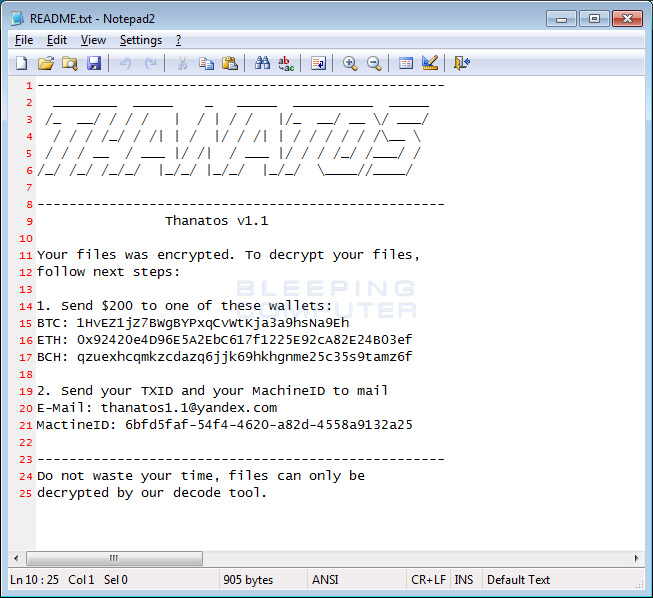
While Thanatos accepts both Bitcoin and Etherum as a ransom payment, this is the first time that Bitcoin Cash has been accepted as shown in the ransom note below.
Thanatos Ransom Note
How Thanatos Encrypts a File
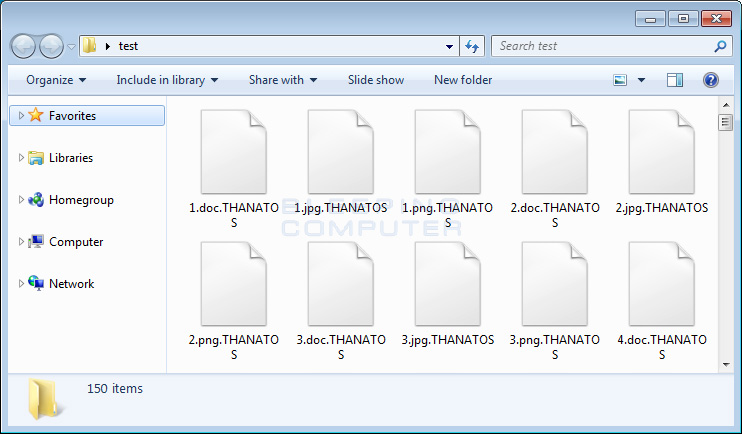
When encrypting files it will append the .THANATOS extension to an encrypted file’s name. For example, a file named test.jpg would be encrypted and renamed as test.jpg.THANATOS.
Thanatos Encrypted Files
After the encryption process is completed, it will then connect to iplogger.com/1t3i37 URL in order to keep track of the amount of victims that have been infected.
Finally, it will generate an autorun key called “Microsoft Update System Web-Helper” that opens the README.txt ransom note every time a user logs in. This ransom note can be seen in the article’s previous section.
This ransom note contains instructions to send a $200 USD ransom payment to one of the listed Bitcoin, Ethereum, or Bitcoin Cash addresses. The user is then instructed to contact thanatos1.1@yandex.com with their unique victim ID in order to receive a decryption program.
If anyone is infected with this ransomware, they should contact us about the possible creation of a brute force program.
How to protect yourself from the Thanatos Ransomware
First and foremost, you should always have a reliable and tested backup of your data that can be restored in the case of an emergency, such as a ransomware attack.
You should also have security software that incorporates behavioral detections to combat ransomware and not just signature detections or heuristics. For example, Emsisoft Anti-Malware and Malwarebytes Anti-Malware both contain behavioral detection that can prevent many, if not most, ransomware infections from encrypting a computer.
Last, but not least, make sure you practice the following security habits, which in many cases are the most important steps of all:
Backup, Backup, Backup!
Do not open attachments if you do not know who sent them.
Do not open attachments until you confirm that the person actually sent you them,
Scan attachments with tools like VirusTotal.
Make sure all Windows updates are installed as soon as they come out! Also make sure you update all programs, especially Java, Flash, and Adobe Reader. Older programs contain security vulnerabilities that are commonly exploited by malware distributors. Therefore it is important to keep them updated.
Make sure you use have some sort of security software installed that uses behavioral detections or white list technology. White listing can be a pain to train, but if your willing to stock with it, could have the biggest payoffs.
Game organizers haveverified rumors that the Olympics were hacked during Friday’s opening ceremony. However, the source of the attack has yet to be revealed. While systems including the internet and television services were affected on Friday evening, organizers assured media that the breach “had not compromised any critical part of their operations,” according to a Reuters report.
Cybersecurity experts noted in January that there were early suggestions that Russia-backed attackers may have wanted a payback as a retaliation against the nation’s ban from the Pyeongchang Games. The Russian federation has not been allowed to compete as a result of anti-doping regulations (though Russian athletes have been taking part of the games as the Olympic Athletes from Russia, or OAR).
Russia denies the hacking and North Korea may also serve as a prime suspect. The hack was short-lived and quickly addressed. “All issues were resolved and recovered yesterday morning
Cleveland and a growing number of other local and state courts, judges are now guided by computer algorithms before ruling whether criminal defendants can go free have to stay locked up awaiting trial.
A bipartisan bail reform movement has found an alternative to cash bail: AI algorithms that can scour through large sets of courthouse data to search for associations and predict which people are most likely to flee or commit another crime.
Experts say the use of these risk assessments may be the biggest shift in courtroom decision-making since American judges began accepting social science and other expert evidence more than a century ago.
Critics, however, worry that such algorithms could end up superseding a judges’ own judgment, and might even perpetuate biases in ostensibly neutral form.
States such as New Jersey, Arizona, Kentucky, and Alaska have adopted these tools. Defendants who receive low scores are recommended for release under court supervision.
Among other things, such algorithms aim to reduce biased rulings that could be influenced by a defendant’s race, gender or clothing — or maybe just how cranky a judge might be feeling after missing breakfast.
The AI system used in New Jersey, developed by the Houston-based Laura and John Arnold Foundation, uses nine risk factors to evaluate a defendant, including age and past criminal convictions. But it excludes race, gender, employment history and where a person lives.
It also excludes a history of arrests, which can stack up against people more likely to encounter police — even if they’re not found to have done anything.
An investigative report by ProPublica found that a commercial system called Compas used to help determine prison sentences for convicted criminals, was falsely flagging black defendants as likely future criminals almost twice as frequently as white defendants.
Other experts have questioned those findings, and the U.S. Supreme Court last year declined to take up a case of a Wisconsin man who argued the use of gender as a factor in the Compas assessment violated his rights.
Advocates of the AI approach argue that the people in robes are still in charge. Others worry the algorithms will make judging more rote over time. Research has shown that people tend to follow specific advisory guidelines in lieu of their own judgment, said Bernard Harcourt, a law professor at Columbia.
India has a severe shortage of psychiatrists and as a result, mental illness in rural areas remain undiagnosed or does not get the proper treatment. Indian researchers have developed a virtual tool to help address this problem. It has been found that it can be used by non-psychiatrists and is as effective as a diagnosis by specialists. The expert system is called clinical decision support system (CDSS) for diagnosis and treatment of psychiatric disorders was developed at the Department of Psychiatry of the Postgraduate Institute of Medical Education and Research (PGIMER), Chandigarh.
The tool covers 18 common mental disorders-delirium, dementia, mania, depression, dysthymia, psychosis, obsessive-compulsive disorder, generalized anxiety disorder, panic disorder, phobias, reaction to severe stress and adjustment disorder, somatoform disorder, dissociative disorder, neurasthenia, sexual dysfunctions, alcohol dependence, substance dependence and mental retardation.
Mental health care is mostly unavailable or inaccessible in most parts of India. About 90 percent patients in need of psychiatric treatment do not get it due to lack of psychiatrists. That gap is filled by creating a virtual psychiatrist. The expert system can assist a non-medical person to interview a patient with mental disorders leading to an automated diagnosis. The ICT technology is very simple to use, just a computer, broadband internet, Skype and a telephone line. Telepsychiatry holds the potential to solve the massive and intertwined problems of underdiagnosing and undertreating persons with mental illness and the lack of trained workforce at the grassroots level.
VR can transmit students to the farthest corners of the universe in just a blink of an eye and surround them with an engaging and deeply educational environment. Students will no longer be stuck with pages upon pages of boring text, bullet points, and illustrations, but they will have a chance to actually go through the experience and get the most out of it instead.
Augmented Reality (AR)
Augmented Reality is a technology that superimposes a computer-generated image on a user’s view of the real world, thus providing a composite view. This, also, includes real-world sensory input like video, graphics, or sound [2].
When it comes to eLearning, Augmented Reality can make the learning process more interesting and easier to grasp. For instance, if you were an online instructor and your target subject was astronomy, you could offer your students a virtual tour of Mars without asking anyone to leave their home.
Artificial Intelligence (AI)
Artificial Intelligence is referred to the intelligence displayed by machines, as opposed to natural intelligence displayed by humans and animals [3]. It is revolutionizing the whole eLearning experience due to the many advantages it has to offer. AI can help highlight areas that require improvement and assist students in focusing on areas where they are lagging.
Big Data
If an employee is interacting with a training module based around company policies, their progress, social sharing, assessment results, and another relevant date that is being generated throughout the eLearning course is referred to as “big data”.
Big Data allows eLearning experts to understand how the users are digesting the information and which learning aspects appeal the most to them. In addition to that, it allows them to pinpoint learning interactions that should be fine-tuned within the eLearning module or course.
Wearable Devices
Wearable devices also referred to as wearables, are smart electronic devices that can be worn on the body as accessories or implants
Machine Learning
Machine Learning is a field of computer science that gives computers the capacity to learn without being directly programmed.
New York Attorney General Eric Schneiderman, has stepped forward with one of the first legal challenges to the commission’s controversial vote. In a open letter to the FCC
New York Attorney General Eric Schneiderman wrote that his office pursued an investigated the incident, but that the FCC basically ignored all of its requests for cooperation. Schneiderman declared his office’s intention to sue to “stop the FCC’s illegal rollback of net neutrality”.
The Federal Communications Commission has voted to deregulate the broadband industry and eliminate net neutrality rules that prohibit Internet service providers from blocking and throttling Internet traffic.
The repeal of net neutrality rules came about a year ago when Donald Trump won the presidency and appointed Republican Ajit Pai to the FCC chairmanship. Pai and Republican Commissioners Michael O’Rielly and Brendan Carr provided the three votes necessary to overturn the net neutrality rules and the related “Title II” classification of broadband providers as common carriers.
Democrats Mignon Clyburn and Jessica Rosenworcel provided bitter dissents in today’s 3-2 vote. Despite the partisan divide in government, polls show that majorities of both Democratic and Republican voters supported the rules, and net neutrality supporters protested outside the FCC headquarters before the vote.
Home Internet providers and mobile carriers will not be held by strict net neutrality rules. ISPs will be allowed to block or throttle Internet traffic, or offer priority to websites and online services in exchange for payment. The Federal Trade Commission could punish ISPs if they make promises and then break them, but there’s no requirement that the ISPs make the promises in the first place.
The Center for Urban Science and Progress moved into 370 Jay Street in Brooklyn.
370 Jay Street will house engineers, research scientists, game designers, media artists, and musicians – all interacting and collaborating under one roof.
Launched in 2012, CUSP has earned a reputation as a leader in the study of urban informatics. The school integrates data and social sciences to understand and improve cities, working to solve challenges ranging from pollution and homelessness to crowded public transportation. The school offers a yearlong MS program that gives students the opportunity to tackle real-world problems in and out of the classroom, partnering with City and State organizations, including the New York City Economic Development Corporation and Department of Environmental Protection. Research projects CUSP has helped launch are the ongoing SONYC noise pollution research initiative that received $4.6 million in funding from the National Science Foundation, and a partnership with Women in Need to create the city’s first smart homeless shelters.
By 2030 up to 30% of the hours worked globally could be automated. According to a new report by the McKinsey Global Institute researchers estimate that between 400 million and 800 million people could find themselves displaced by automation and in need of new jobs, depending on how quickly new technologies are adopted. Of this group, as many as 375 million people—about 14% of the global workforce—may need to completely switch occupational categories and learn a new set of skills to find work.
Number of workers needing to find new jobs due to automation
It’s called the Quad9 Domain Name System (DNS) service and it is designed to protect internet users from accessing sketchy websites that are known for spreading malware, stealing personal information and fraudulent activity.
Once set as your DNS service, every time you click on a web link, Quad9 will check the site against IBM-X-Force’s threat intelligence database of over 40 billion analyzed webpages and images.
HOW TO SET QUAD9 ON WINDOWS:
1. Pull up Network Connections by right-clicking on the Start menu.
2. Now click on “Change adapter options.” You’ll see your current network; right click and choose Properties.
3. Select Internet Protocol Version 4 (TCP/IPv4) and click on Properties.
4. On the Preferred DNS server field, type in 9.9.9.9, then click OK.
Mac users, don’t despair. Here are the steps to change your DNS settings on a MacOS:
HOW TO SET QUAD9 ON A MAC:
1. Open Settings, then select Network. Click on the Advanced button.
2. Next, go to the DNS tab.
3. Click the plus (+) sign on this tab, then type in 9.9.9.9.
4. Press OK and you’re set!
Note: You’ll need administrator rights to make these changes.
YOUR ROUTER NEEDS THIS ONE THING MANUFACTURERS DON’T TELL YOU
Checking for updates is a critical step to your computer, gadgets and installed software and applications. The reason for this is two-fold. First, you can take advantage of all the new features and improvements to the new version.
Net neutrality is the concept that internet service providers (ISPs) treat everyone’s data equally – whether that’s an email from your family member, a bank transfer or a streamed movie. Meaning that ISPs, which control the delivery , don’t get to choose which data is sent more quickly, and which sites get blocked or throttled (for example, slowing the delivery of a TV show because it is streamed by a video company that competes with a subsidiary of the ISP) and who has to pay extra. For this reason, some have described net neutrality as the “first amendment of the internet”.
Why is net neutrality under threat?
In February 2015, the Federal Communications Commission (FCC) voted to more strictly regulate ISPs and to enshrine in law the principles of net neutrality. The vote reclassified wireless and fixed-line broadband service providers as title II “common carriers”, a public utility-type designation that gives the FCC the ability to set rates, open up access to competitors and more closely regulate the industry. Two years later, Trump’s new FCC chairman, Ajit Pai, a former Verizon lawyer, has pushed to overturn the 2015 order arguing they overstep the FCC’s jurisdiction and hinder corporate innovation. On 18 May, the FCC voted to support a new proposal that would repeal the order and started a 90-day period in which members of the public could comment. A final vote is expected in December.
AI technologies like speech analytics, deep-learning platforms and natural language generation have exploded onto the scene in the past 12 months. Soon firms will be able to automate and scale in a more efficient way because software will ultimately be able to learn and adapt rather than require programming.
Automation will transform the workforce as technology advances result in humans increasingly working side by side with software robots These robots don’t herald a gloomy future for jobs. As we showed in our report. Working Side By Side With Robots, automation will replace some jobs and create others, with a net loss of 9.8 million US jobs by 2027 — while transforming at least 25 percent of the remaining jobs.
The newest developments show that using sodium, zinc, and aluminum constructed batteries make the mini-grid a solid possibility for providing 24-7, reliable and clean energy to entire small rural towns.
2-D Materials
New materials such as Graphene are emerging and are going to change the world forever. Think about the Bronze Age…the Iron Age—these newest materials each contain a single layer of atoms and are two-dimensional. The potential positive impacts of evolving materials are limitless and bound only to the reach of scientists and how far they choose to push.
Autonomous Transportation
Self-driving cars are already in the here-and-now, but just how soon will be helping to improve the lives of handicapped and elderly will change the quality of life for millions.
Personal AI
From your own personal robot assistant that can anticipate your every need and perform tasks at your whim, to entire AI environments—this could be affordable to everyone with the emerging availability of Open AI ecosystems.
The Department of Homeland Security told Congress this summer that it suspected that 21 states were targeted, by hackers.
In June, DHS Acting Deputy Undersecretary for Cybersecurity and Communications Jeanette Manfra told a US Senate Intelligence Committee that “internet-connected election-related networks, including websites, in 21 states were potentially targeted by Russian government cyber actors,” but didn’t disclose which states were impacted.
DHS officially contacted election officials in each state and six territories on Friday to “fill them in on what information the agency has about election hacking attempts in their state last year,” according to NPR. State officials from Alabama, Alaska, Arizona, California, Colorado, Connecticut, Delaware, Florida, Illinois, Iowa, Maryland, Minnesota, Ohio, Oklahoma, Oregon, Pennsylvania, Virginia, Washington, and Wisconsin say that they were among those contacted. NPR reports that officials in Georgia, Kansas, Kentucky, Louisiana, New Mexico, and North Carolina say that they were not amongst those contacted.
1000 Black techies, thought leaders, and entrepreneurs in 1 room for 2 days on the water in San Francisco? AfroTech, the largest black tech conference in Silicon Valley!
With two full days of the latest technologies and hottest startups, you will have a chance to learn from some of the best, and connect with fellow innovators.
The Standford Study suggests that computers have a better ‘gaydar’ than humans brings up all sorts of questions about the morality of such technology and the potential consequences of it falling into the wrong hands.
An algorithm associated with the software correctly identified gay men 81% of the time, while it was accurate for 74% of the women it tested.
Research of more than 35,000 faces – taken from a dating website – was published in the Journal of Personality and Social Psychology and first reported in the Economist, and claimed that gay men and women had ‘gender-atypical’ features, expressions and grooming styles.
Data also claimed to show that gay men had narrower jaws, longer noses and larger foreheads than straight men.
The paper claims to show for once and for all that exposure to certain hormones before birth determines sexual orientation; that being gay is not a choice, in other words.
However, those critical of the research claim that the technology could easily fall into the wrong hands.
The fear is that spouses could use it to identify a ‘closeted’ husband or wife, or that teenagers could deploy it as a means of outing their peers. Worse again, that anti-gay governments – such as Russia – could use it to target members of a country’s population.
Critics suggest that profiling people based on their appearance, then identifying them is wrong.
Equifax was hacked and they have information on 143 million Americans. The supposed hackers have made their demands of Equifax. The hackers are asking for over 600 Bitcoin – that much Bitcoin amounts to $2.66USD million. The hackers claim that if Equifax pay up , they will delete all of the data. Equifax has until September 15th to pay up.
The hackers have told Equifax to request any part of the stolen data and they will show it to them to prove that they’re legitimate.The hackers have given Equifax until September 15 to pay the ransom or the data will be publicized.
A proposed class-action lawsuit was filed against Equifax Inc. late Thursday evening, shortly after the company reported that an unprecedented hack had compromised the private information of about 143 million people.
A complaint was filed in Portland, Ore., federal court, users alleged Equifax was negligent in failing to protect consumer data, choosing to save money instead of spending on technical safeguards that could have stopped the attack. Data revealed included Social Security numbers, addresses, driver’s license data, and birth dates. Some credit card information was also put at risk.
The cyber attack today, which occurred sometime between the middle of May 2017 and July 29. What makes the Equifax attack particularly troublesome is the company’s status as a central clearinghouse for sensitive credit-related information including social security numbers, driver’s license numbers, and other data that can be used in a variety of ways to harm those affected.
While the Equifax breach isn’t the largest in terms of the number of victims — however,because of the kind of personal information that was stolen is troubling. Examples of sensitive information include 209,000 credit card numbers, personal information relating to credit disputes for 182,000 victims, and data that could be further used to access medical histories, bank accounts, and more.
If you have a credit report, chances are you may be in this breach. The chances are much better than 50 percent.”
An artificial “earthquake” in North Korea created by a hydrogen bomb was felt throughout the region today. The “artificial quake” measured 6.3-magnitude and was followed by a 4.6-magnitude quake originating near the North’s main testing site at Punggye-ri.
The Russian ministry issued a statement on today urging immediate dialogue and negotiations. It says that’s the only way settle the Korean Peninsula’s problems, “including the nuclear one. The ministry says Russia reaffirms its readiness to participate in negotiations, “including in the context of the implementation of the Russian-Chinese road map.”
Under that proposal, North Korea would suspend nuclear and missile tests in exchange for the US and South Korea suspending their joint military exercises.
US President Donald Trump has reportedly held a 20-minute phone conversation with Japanese counterpart Shinzo Abe following North Korea’s H-bomb test.
Spokeswoman Ri Chun-hee — AkA “The Pink Lady” — announced the country’s sixth nuclear test was “a perfect success”.
In this undated image distributed on Sunday, Sept. 3, 2017, North Korean leader Kim Jong Un inspects the loading of a hydrogen bomb into a new intercontinental ballistic missile. Picture: Korean Central News Agency/Korea News Service via APSource:AP
With an atmosphere of light steampunk horror, including a somewhat disturbing version of The Colonel asking you to kindly fry some chicken, The Hard Way appeared to be an elaborate marketing campaign, but PC Gamer received an official response suggesting that the project is indeed going to be introduced to new employees in the future.
“KFC will use the VR simulation to supplement its robust, multi-step employee training program, called Chicken Mastery Certification, which provides detailed eLearning and hands-on training for cooks in each of KFC’s kitchens. KFC will provide another platform for training by bringing the VR simulation technology to its regional general manager training classes, quarterly franchise meetings, and employee onboarding.
Buddhist priest for a funeral cost about $2,200 in Japan. So a plastic molding company Nissei Eco Co. decided to create a robotic Buddhist priest. Nissei has modified an existing robot in the form of SoftBank’s Pepper robot. The Buddhist Pepper robot is going to be around $450 per funeral.
Use different passwords for each app and website. Now the National Institute of Standards and Technology is about to make all of our lives much easier. The organization recently revised its guidelines on creating passwords, and the new advice sharply diverges from previous rules.
Longer passwords that are harder for hackers to break the longer the better. Previously, security experts recommended the use of password manager apps to ensure users’ accounts were protected. The apps are useful because they completely randomize the password, but he says they aren’t necessary to maintain security.
Dr Jeffrey Lieberman from Columbia University says” the new technologic innovation that is emerging and which does seem likely to impact psychiatry and mental health care in a time that is commensurate with the other specialties of medicine, is the technology that informs how we use Internet-based smartphone mobile app devices. The rudimentary ways in which this has already begun to permeate medicine and mental health care include electronic health records and telemedicine, which is ideally suited to psychiatry in terms of being able to provide consultation at a distance.“The initial idea is to have smartphone-based applications that can perform several functions. One is a monitoring function: having apps that can passively monitor the activities or biologic signals of an individual—whether it is movement, heart rate, respiratory rate, or level of activity—and have an ongoing record that can be catalogued, observed, and interpreted by clinicians. A second function is as a means of communication. Doctors already have begun to employ FaceTime, Skype, and texting to maintain contact with patients remotely in a variety of situations. Another area would be to develop apps that could provide some kind of actual therapeutic assistance, including cognitive-behavioral therapy, motivational interviewing, and supportive types of techniques or protocols when needed. All of these have great potential and can expand the reach of healthcare providers, psychiatrists, and mental health care clinicians, and provide help to a larger proportion of people when they need it.”
Soniac was one of the three apps found on Google Play, according to a blog post published Thursday by a researcher from mobile security firm Lookout. The app, which had from 1,000 to 5,000 downloads before Google removed it. Soniac had the ability to record audio, take phones, make calls, send text messages, and retrieve logs, contacts, and information about Wi-Fi access points. Google ejected the app after Lookout reported it as malicious. Two other apps—one called Hulk Messenger and the other Troy Chat—were also available in Play but were later removed. It’s not clear if the developer withdrew the apps or if Google expelled them after discovering their spying capabilities. The apps are all part of a malware family Lookout calls SonicSpy.
Once installed, SonicSpy apps remove their launcher icon to hide their presence and then establish a connection to the control server located on port 2222 of arshad93.ddns[.]net.
The researcher said SonicSpy has similarities to another malicious app family called SpyNote, which security firm Palo Alto Networks reported last year. The name of the developer account—iraqwebservice—and several traits found in the apps’ code suggest the developer is located in Iraq. Additionally, much of the domain infrastructure associated with SonicSpy has references to that country. The phrase “Iraqian Shield” appears constantly. Lookout is continuing to follow leads suggesting the developer is based in that part of the world.
Nothing is certain just yet, but discussions are a positive step forward for the recognition of esports at the Olympics.
Esports will be present at the Asian Games, the Olympic Council of Asia announced in April. An event recognized by the IOC, the Asian Games’ esports program will likely help push along the Paris Olympic bid committee with their discussions.
Team EnVyUs has secured a major investment from Hersh Family Investment and Interactive Group, according to an ESPN report.
The group is led by Kenneth Hersh, an executive in the oil and natural gas industry, and is based in Texas. The company reportedly offered EnVyUs a $35 million deal, which would make it one of the biggest acquisitions in the esports sector. EnVyUs is headquartered in Charlotte, North Carolina, but will relocate to Dallas to align with its reported Overwatch League slot, ESPN said.
Hackers who posted several of HBO’s new episodes and a “Game of Thrones” script online in late July have published a month’s worth of emails from the inbox of one of the entertainment company’s executives. The Hackers also addressed a video letter to HBO CEO Richard Plepler that demands the company demand payment of money, although the figure was redacted, according to the report. The hackers said HBO marked their 17th victim, and only three have failed to pay. HBO said its forensic review of the incident is ongoing and noted that it believed further leaks were forthcoming.
HBO private emails in the hands of hackers, came Monday in an email message to The Hollywood Reporter that also contained nine files with such labels as “Confidential” and “Script GOT7.” The hackers also delivered a video letter to HBO CEO Richard Plepler that says, “We successfully breached into your huge network. … HBO was one of our difficult targets to deal with but we succeeded (it took about 6 months).”
They say that the frequency of the attacks has overwhelmed the FBI’s Los Angeles field office, which has been unable to properly investigate all of them. The FBI’s surprising advice, according to industry sources: Pay the ransom.
FBI spokesperson in the L.A. office denied that the agency is telling companies to cough up the bitcoins in cases of ransomware. “The FBI does not encourage payment of ransom as it keeps the criminals in business,” says Laura Eimiller. “Of course, the individual victim must weigh their options.”
“The FBI will say it’s easier to pay it than it is to try to fight to get it back,” says Hemanshu Nigam, a former federal prosecutor of online crime in L.A. and onetime chief security officer for News Corp. “And if one company pays the ransom, the entire hacking community knows about it.”




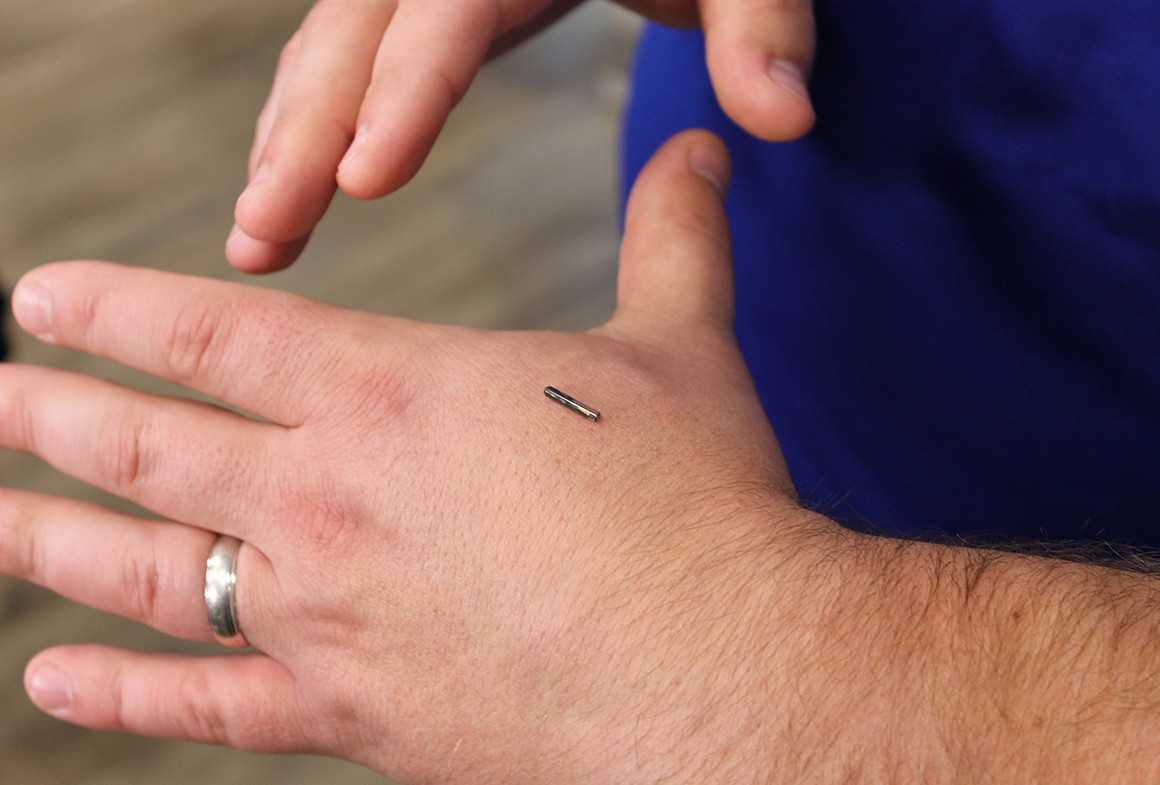







 Photo: Getty























)


 Ongoing Information & Trends: A Weblog
You must be logged in to post a comment.