Here’s A Story That’s Fact


Google has tracking what you buy through your Gmail inbox and storing them in a Google Account page that was a secret. This purchase tracking has gone on for several years before being discovered. A list is created of your online shopping history that can stretch back five years. Google claims it is doing this to help its users keep track of everything they’ve purchased in one place — but people are seeing this as an invasion of privacy. Google says and has promised that you’re the only one who can see this data.
Here’s what you can do to delete the info Google has stored.
1. Google tracks multiple email types through Gmail, including purchases, payments, subscription services and reservations, say for hotels, cars and airline tickets. To view and manage them, start by navigating to https://myaccount.google.com/.
2. Select Payments & subscriptions.
3. From here, you can click into each grouping. You can view items here, which could include a subscription to YouTube or Google Photos.
4. Click into each item and tap “Remove reservation,” “Remover purchase” and so on to delete anything you don’t want stored in your Gmail account.
Your Web and App Activity includes searches through Google, Maps and Play. This is how you can update your settings. You’ll be able to pause activity from being recorded and delete anything that has been saved — especially private information.
1. Visit https://myaccount.google.com/.
2. Select Data & personalization.
3. Tap or click Manage your activity controls.
4. From here, you can turn off and delete activity being saved to Google. Even if you’re not online, Google is still able to keep track of your activity and will sync the data once you’re online, so keep your Web & App Activity off if you want to keep things private.

Game of Thrones (HBO)
George R.R. Martin once believed that his fantastical tale consisting of countless characters, epic battles, castles and dragons — was too expensive and expansive to film. But executive producers David Benioff and D.B. Weiss, proved him wrong.
“Killing Eve” (BBC America)
British author Luke Jennings wanted to have some fun and turn the espionage thriller genre on its head with his “Codename Villanelle” novella series about two mutually obsessed women — one a brainy MI-6 agent and the other a sociopathic assassin. Adapted for TV by Phoebe Waller-Bridge (“Fleabag”), it quickly became a fast-paced, sexy, suspenseful and hilarious hit.
“Outlander” (Starz)
On-screen characters aren’t always what the author envisioned. But from the start, Diana Gabaldon loved the casting of Caitriona Balfe (Claire) and Sam Heughan (Jamie) in TV’s version of her time-traveling historical novels.
“The Handmaid’s Tale” (Hulu)
Margaret Atwood’s 1985 novel about a dystopian era in which women are treated as property of the state has a chilling resonance in the #MeToo era. Elisabeth Moss earned an Emmy Award for her blistering portrayal of Offred, a “handmaid” who strikes out against the restrictions imposed on her.
“A Series of Unfortunate Events” (Netflix)
The 2004 feature film starring Jim Carrey was an unfortunate misfire. Luckily, this spellbinding adaptation of Daniel Handler’s Lemony Snicket stories is superior in nearly every way.

A billionaire technology investor has shocked graduating students in Atlanta, Georgia, by telling them he will pay off all of their student loans.
Robert F Smith, one of America’s most prominent black philanthropists, was giving an address at Morehouse College, a historically all-male black college.
Nearly 400 students will benefit at a cost of tens of millions of dollars.
The class of 2019 and their teachers were stunned at the news before applausing.
Robert F. Smith, this year’s commencement speaker, made the announcement Sunday morning while addressing nearly 400 graduating seniors of the all-male historically black college in Atlanta.
“On behalf of the eight generations of my family that have been in this country, we’re gonna put a little fuel in your bus,” Smith told the graduates. “This is my class, 2019. And my family is making a grant to eliminate their student loans.”
A former chemical engineer and investment banker, he is the founder, chairman, and CEO of private equity firm Vista Equity Partners. In 2018, Smith was ranked by Forbes as the 163rd richest person in America. He was No. 480 on Forbes 2018 list of the world’s billionaires, with a net worth of US$4.4 billion.

Huawei says bans will not slow them down and it’s” full steam ahead”.
Full steam ahead: A U.S. ban on sales of electronic components to #Huawei will not stop the tech giant from rolling out #5G mobile networks in Europe. #HuaweiFacts https://t.co/TLoLmxzqc3
— Huawei Facts (@HuaweiFacts) May 20, 2019
The United States Department of Commerce added Huawei to its “Entity List” on Wednesday, prohibiting the company from acquiring parts and components from U.S. companies without the approval of the federal government, which filed criminal charges against the Chinese telecommunications giant in January. Officials told Reuters that the decision will make it difficult, if not impossible, for Huawei to sell some products due to its reliance on U.S. suppliers. Huawei immediately pushed back against the decision to add the company to the list, issuing a statement on Friday that it would do more harm than good.
Info retrieved from Digital Trends
Apple Park is Apple’s second campus in Cupertino, California. It is often referred to as the “spaceship” campus due to its unique ring-shaped design. Encompassing 2.8 million square feet and spanning 176 acres, construction on the campus started in 2013 and work was largely completed by the end of 2017.

Citizen
– Five Staten Island librarians help find missing elderly man in Manhattan (Provided by Citizen)

President Trump has issued an executive order that paves the way for the US government to ban technology sales from Chinese vendor Huawei and anyone else it views as a national security threat.
The executive order, published on Wednesday, does not mention countries or companies by name. But it comes as the White House is facing a trade war with China. The Trump administration has also been outspoken in trying to stop adoption of Huawei’s 5G technology over concerns it’ll lay the groundwork for Chinese state-sponsored espionage.


Magnetic Resonance Imaging (MRI) scan may trigger feelings of discomfort, anxiety and sometimes fear. Now a new kind of coil technology changing the game on this experience, while helping radiologists get clear images for confident diagnoses.
During an MRI scan, technologists use an “RF coil” to capture and listen to the electro-magnetic waves coming from the part of the body radiologists are imaging. This rigid coil acts like an antenna picking up signals from a patient’s body and converting them to images. But they’re usually bulky, heavy and uncomfortable for patients and technologists alike.
AIR Technology Coils are designed to conform to the human body just like a comfortable blanket. It uses innovative conductor material designed for ultra-flexibility, and each coil is lightweight and flexible to closely wrap around patients for incredible image quality.

The United Nations issued its first comprehensive global scientific report on biodiversity, which explored the threat of extinction for Earth’s plants and animals. (Ben Curtis, File/Associated Press)
Species loss is accelerating to a rate tens or hundreds of times faster than in the past, the report said. More than half a million species on land “have insufficient habitat for long-term survival” and are likely to go extinct, many within decades, unless their habitats are restored.
The Intergovernmental Science-Policy Platform on Biodiversity and Ecosystem Services (IPBES) included more than 450 researchers who used 15,000 scientific and government reports. The report’s summary had to be approved by representatives of all 109 nations.
Some nations hit harder by the losses, like small island countries, wanted more in the report.
Five ways people are reducing biodiversity:
Since 1996, the amur leopard has been classified by the IUCN as Critically Endangered with less than 70 individuals thought to exist today.

Cross River Gorillas and Mountain Gorillas are both classified as Critically Endangered and Endangered by the IUCN since 1996 – that is two out of five gorilla subspecies. There are currently only 200-300 Cross River Gorillas left in the wild, and 900 Mountain Gorillas.

Two types of sea turtles are amongst the most endangered species in the world: the Hawksbill Turtle and the Leatherback Turtle
In the past 100 years, the Hawksbill Turtle has lost 90 percent of its population, 80 percent of which has been lost in the past 10 years. As of 1996, the IUCN classified it as a critically endangered species. The Leatherback turtle is listed by the IUCN as Vulnerable, yet many subpopulations are facing extinction.

Since the millennium, the Sumatran Orangutan has been classified by the IUCN as Critically Endangeredwith approximately 80% of the population lost in the past 75 years mainly as a result of mass deforestation. This awful trend continues to put pressure on the remaining population of 6,600 Sumatran Orangutans that are estimated to remain on this earth.

In the past 25 years, the Sumatran Elephant has lost an astounding 70% of its habitat to deforestation for palm oil plantations, agriculture and human settlements. Less than 2000 are estimated to exist and in 2011, the Sumatran Elephant was classified by the IUCN as Critically Endangered.

In 1992, the discovery of this mystical creature, sometimes referred to as the Asian Unicorn, in Vietnam was hailed one of the most spectacular zoological discoveries of the 20th century. Yet already, this elusive and beautiful animal been deemed by the IUCN to be Critically Endangered and is one of the rarest large mammals to exist on Planet Earth.

With less than 100 thought to exist, the Vaquita is the rarest marine mammal in the world. Time is running out for these elusive little sea porpoises, with extinction predicted as soon as 2018.

The tiger has long been hunted for its distinctive patterned fur. Of the nine tiger subspecies, three are already extinct, many are endangered but it is the South China Tiger and the Sumatran Tiger that currently face the biggest threat to their survival.
Tragically, the South China Tiger is thought to be extinct in the wild as it hasn’t been spotted since the 1970s. The Sumatran Tiger is the only surviving tiger subspecies indigenous to Indonesia and as of 2008 it has been classified by the IUCN as Critically Endangered. Less than 500 of these tigers exist today in comparison with a population estimation of up to 1,000 in 1978.

Three of the five species in the family of Rhinocerotidae, are among the most endangered species in the world: the Black Rhino, the Javan Rhino and the Sumatran Rhino. The Javan Rhino is the most threatened with extinction with the total population of only 60 surviving in one National Park in Java, Indonesia. The Sumatran Rhino is Critically Endangered. It has been estimated that less than 100 exist today in the wild. The Black Rhino is classified by the IUCN as Critically Endangered with three subspecies declared extinct in 2011.

Despite their tough appearance, these small, warrior built mammals are losing the battle against poachers and habitat loss. All eight species of pangolin are under threat, ranging from Vulnerable to Critically Endangered. They are the most trafficked animal in the world, hunted for their scales which can be sold on the black market for up to $3,000/kg.


Robotics director,Scott Anderson, of Amazon robotics fulfillment, told a group of reporters during a visit to Amazon’s Baltimore warehouse on Tuesday that the company is 10 years away from replacing certain human jobs.
He was referring specifically to the picking process, which would require robots to select a single product from a bin without picking up or damaging other items.
The technology is very limited and extremely far from the fully automated workstation thats needed.
According to a recent report by TechCrunch, Amazon now has more than 100,000 robots in operation. According to Amazon, none of these robots are currently used in warehouses that handle fresh food because of the need for human intelligence.

The African-American code-breaking unit at Arlington Hall.COURTESY OF NATIONAL SECURITY AGENCY
Candidates must be highly skilled in math and linguistics, willing to relocate and able to keep a secret to the death. Only college age women with no imminent wedding plans need apply.
A number of librarians had been recruited to decipher unfiled smatterings of coded messages for the U.S. Navy during World War II.
The US military, caught by surprise at Pearl Harbor, realized they needed to quickly set up a code-breaking unit. They turned to thousands of women with classical liberal arts educations and built on those skills to assemble teams of expert code breakers. Like their counterparts working at England’s Bletchley Park, the American women’s collegiate experience reading and interpreting complex texts or wrestling with advanced mathematics prepared them well for untangling the shifting, arcane world of crypotanalysis.
Librarians brought their own skills to the teams. In addition to breaking codes, these professionals, mostly women, set the stage for their teams’ successes. They kept records. They organized vast amounts of disordered and unrelated information into logical categories. And by applying the principles of indexing and cataloging, they connected previously disjointed information and made it discoverable.
Code-breaking women who had secretly signed their lives away without a pause. while their fathers and brothers, boyfriends and husbands, had gone off to fight on the front lines. But these women—more than 10,000—didn’t sit at home and wait. When their country called, they answered and they fought, too.
Looking through archives, local journalist and author Liza Mundy came across librarian Jaenn Magdalene Coz’s writing. Immediately, she knew they’d be the epigraph of the book she was working on, Code Girls: The Untold Story of the American Women Code Breakers of World War II.
Over the past several years, Mundy relentlessly combed through archival records for her book. She pored over data, documents, and all there was to be read about the code girls, drawing from three large collections produced by the Army and Navy during and after the war. Most of these collections had been classified for decades. Now, many of the documents are available at the National Archives at College Park.
Mundy managed to track down and interview more than 20 of these code breakers, now in their 90s. She could tell some of the women were “fading,” but they still happily told her tales of what they could remember about that time in their lives, and the archives backed up their memories.

Navy code breaker Edith Reynolds White (middle) unwinds with colleagues.
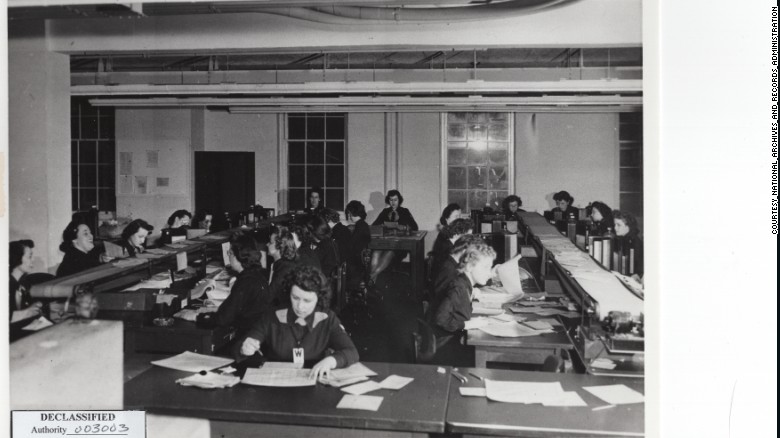 Navy women broke enemy naval codes used across the world, helping in the effort to shoot down the plane of Adm. Isoroku Yamamoto.
|
Richard James Hayes
|
|
|---|---|

Richard Hayes at his day job of director of the National Library
|
|
| Born |
Richard James Hayes
1902 Abbeyfeale, Co. Limerick, Ireland
|
| Died | 1976 |
| Nationality | Irish |
| Occupation | Librarian, code breaker |
Uber apologized Monday after its automated Twitter account responded to a customer with the N-word. The Twitter user had adopted the racial slur as a username, which some believe might have been a deliberate move to trick the automated system.
The customer, whose Twitter handle was @realtheeCheney, messaged Uber about an unpleasant experience, tweeting “I had an awful driver today. I want my money back!!! Please respond so we can work this out.” Uber’s support account responded in a tweet with “We’re so sorry about that, (N-word)! Please send us a DM with your phone number with additional details of your concern so we can connect.”
With, this being the internet, a troll was involved in this sordid mess. Apparently responding to a customer complaint about a bad driver, the company replied that it was sorry, and then called the alleged customer a vile racist slur.


This Air Horse One departed for Louisville from Ontario, California, just before 7 a.m. For this trip, a horse’s ticket on Air Horse One costs about $5,000, but these steeds get first-class treatment. The crew of five humans attends to the horses over the three-hour flight by feeding them hay and water and keeping the cabin at a cool 55 degrees. Payne says the cooler temperatures keep the horses docile. If it’s too hot, they could get sick.


The crew has to take apart the stalls one by one to get the horses off the plane.


Facebook’s redesigned site is supposed to make it easier for users to send private messages and not post many public messages. Messenger is also getting end-to-end encryption to stop eavesdroppers in their tracks, but the feature isn’t coming any time soon.
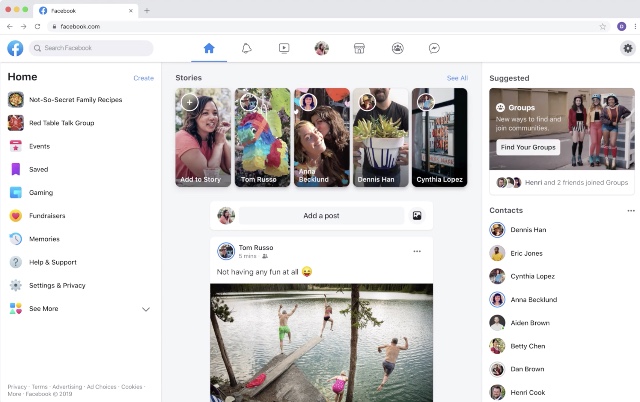
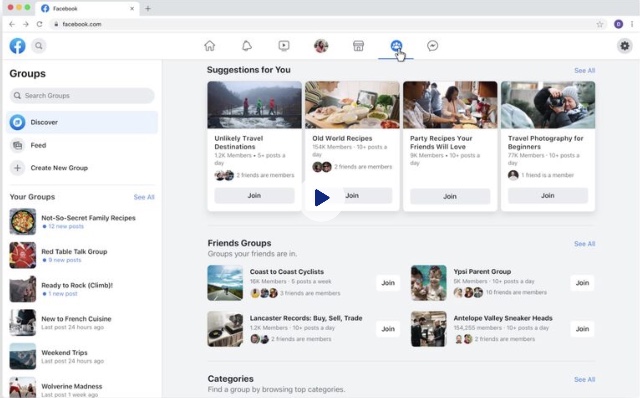
The updates make Facebook much easier to navigate, particularly for groups and messages, which are much more prominent. It’s part of a new focus on private conversations: encouraging friends, families, and individuals with shared interests to chat in private groups or messages rather than posting everything publicly.
The company is rolling out a new AI to moderate the site. The AI uses what’s called “self-supervised learning” to quickly find hate speech, scams, abuse, violence, fake accounts, bullying, and other bad behavior. This kind of content can be anything from mildly unpleasant to outright dangerous, and it’s great that Facebook is looking for solutions to get rid of it.
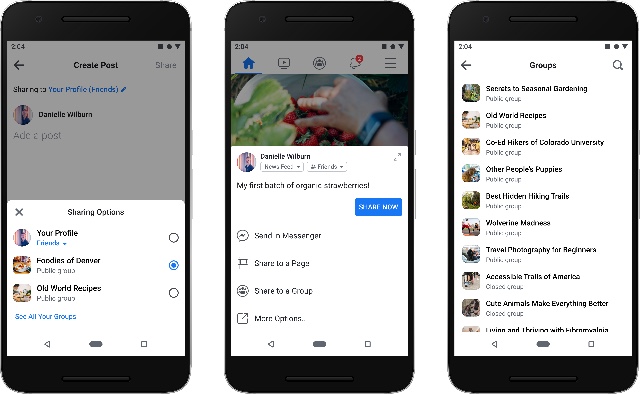
The Facebook app and Messenger app have both been updated with a similar design. Both have a streamlined new interface with a simple row of tabs along the bottom of the screen to quickly navigate. Like the Facebook website, the Facebook app has a bigger focus on private groups, making it easier to find and browse groups, as well as chat and share in groups
The site is adding a Meet New Friends feature that suggests people you might get along with based on shared interests, groups, or location. If you want to meet people through Facebook, you’ll have to turn the feature on and you’ll only see people who have also turned it on.
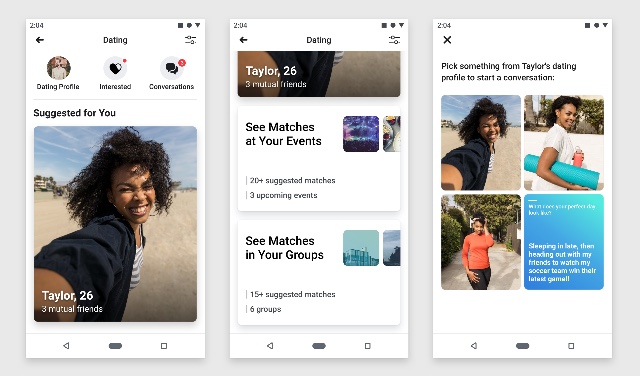
If you’re looking for more than friends, there’s also Facebook Dating. It’s very similar to Meet New Friends: you’ll have to enable it manually, and you’ll only see other users who have enabled it. To use it, you’ll have to create a dating profile, but don’t worry, because it won’t be part of your public profile.
A feature called Secret Crush rounds out Facebook’s suite of friend-finding features. This lets you select up to nine friends that you have a secret crush on, and if they also select you, your crush will be revealed.
If you aren’t interested in finding friends (or dates), these new features won’t be enabled by default, so they’re easy to ignore. Whether you’re interested in Facebook Dating or not, updates to the Facebook apps and websites make them much easier to use. If you use Facebook, there’s something you’ll like in this overhaul — so update your apps and check it out!
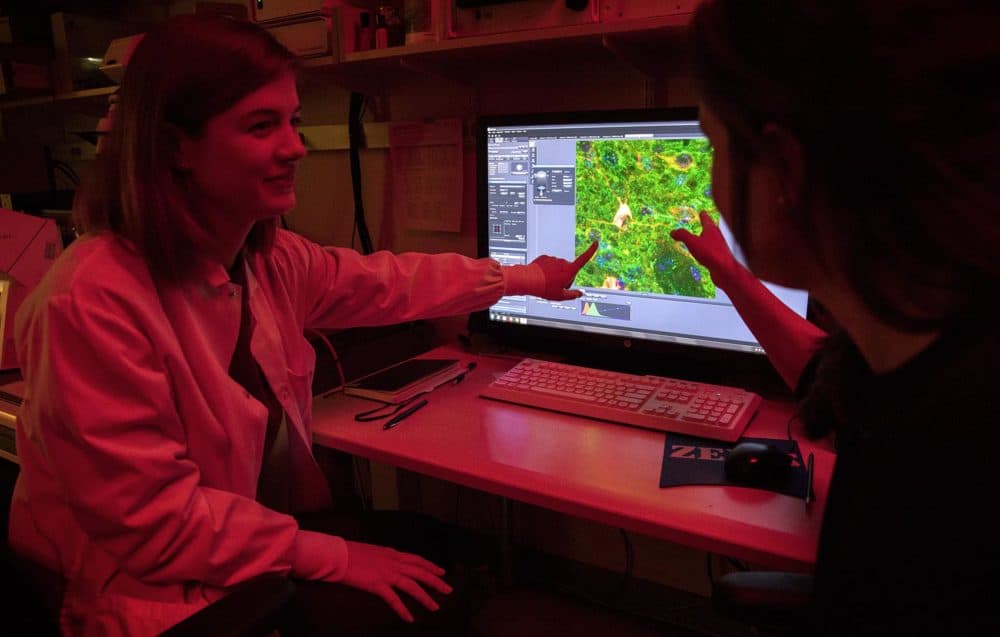
Amanda Vernon, left, reviews an image of cells in a mouse brain with MIT professor Myriam Heiman. The $9 million donation includes about $1 million for work in Heiman’s lab. (Robin Lubbock/WBUR)
The Manhattan-based donor Bob Broderick made tens of millions of dollars by investing in the legal marijuana industry in Canada. So now he’s funneling some of his money for solid research on how cannabis affects the brain.
Professor John Gabrieli director of the Martinos Imaging Center at MIT says heavy cannabis use is very widespread among people with schizophrenia, and it’s not clear to what extent cannabis is helpful or harmful to them.
“That’s why we need the science,” he says. “Because right now, it’s happening without the science, and it’s likely to happen all the more as marijuana becomes highly available legally in many states.”
Federal science authorities have called for major new research on the potential benefits and harms of cannabis use. The National Institutes of Health are supporting more than $140 million of research on cannabinoids.
But support from private donors has been real slow rolling in. Late last year, Inside Philanthropy, reported on a gift of nearly $5 million to support cannabis research at the University of California San Diego, under the headline “Where Most Donors Fear To Tread.”







 Ongoing Information & Trends: A Weblog
You must be logged in to post a comment.