Librarians That Were Code Breakers During The World War 2

The African-American code-breaking unit at Arlington Hall.COURTESY OF NATIONAL SECURITY AGENCY
Candidates must be highly skilled in math and linguistics, willing to relocate and able to keep a secret to the death. Only college age women with no imminent wedding plans need apply.
A number of librarians had been recruited to decipher unfiled smatterings of coded messages for the U.S. Navy during World War II.
The US military, caught by surprise at Pearl Harbor, realized they needed to quickly set up a code-breaking unit. They turned to thousands of women with classical liberal arts educations and built on those skills to assemble teams of expert code breakers. Like their counterparts working at England’s Bletchley Park, the American women’s collegiate experience reading and interpreting complex texts or wrestling with advanced mathematics prepared them well for untangling the shifting, arcane world of crypotanalysis.
Librarians brought their own skills to the teams. In addition to breaking codes, these professionals, mostly women, set the stage for their teams’ successes. They kept records. They organized vast amounts of disordered and unrelated information into logical categories. And by applying the principles of indexing and cataloging, they connected previously disjointed information and made it discoverable.
Code-breaking women who had secretly signed their lives away without a pause. while their fathers and brothers, boyfriends and husbands, had gone off to fight on the front lines. But these women—more than 10,000—didn’t sit at home and wait. When their country called, they answered and they fought, too.
Looking through archives, local journalist and author Liza Mundy came across librarian Jaenn Magdalene Coz’s writing. Immediately, she knew they’d be the epigraph of the book she was working on, Code Girls: The Untold Story of the American Women Code Breakers of World War II.
Over the past several years, Mundy relentlessly combed through archival records for her book. She pored over data, documents, and all there was to be read about the code girls, drawing from three large collections produced by the Army and Navy during and after the war. Most of these collections had been classified for decades. Now, many of the documents are available at the National Archives at College Park.
Mundy managed to track down and interview more than 20 of these code breakers, now in their 90s. She could tell some of the women were “fading,” but they still happily told her tales of what they could remember about that time in their lives, and the archives backed up their memories.

Navy code breaker Edith Reynolds White (middle) unwinds with colleagues.
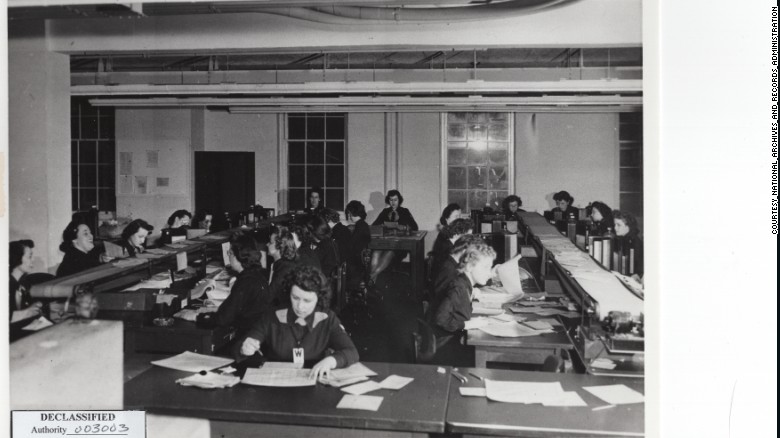 Navy women broke enemy naval codes used across the world, helping in the effort to shoot down the plane of Adm. Isoroku Yamamoto.
|
Richard James Hayes
|
|
|---|---|

Richard Hayes at his day job of director of the National Library
|
|
| Born |
Richard James Hayes
1902 Abbeyfeale, Co. Limerick, Ireland
|
| Died | 1976 |
| Nationality | Irish |
| Occupation | Librarian, code breaker |

 Ongoing Information & Trends: A Weblog